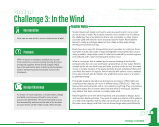
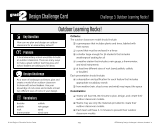
Challenge 3: Outdoor Learning Rocks!
© 2019 Region 4 Education Service Center135
2 2
grade grade
STEMulating Design Challenges in Science, Grades K–2
Teacher Notes Teacher Notes
Key Question
How can we plan and design an outdoor classroom
for an elementary school?
Problem
A local elementary school would like to build an
outdoor classroom. There are many ways to make a
great outdoor learning area, and school leaders are
asking you for ideas.
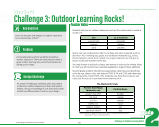
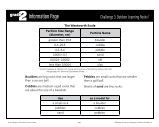
Students will plan an outdoor classroom and use the scale below to create a
model of it.
Teams can use cardboard box lids for the base and other materials such as
aluminum foil, modeling clay, paper, and cardboard materials (e.g., boxes,
sheets, tubes) to create their models. You may be asked to use hot glue to
secure rocks and materials to the box.
You may choose to add color, shape, and texture of rocks to the criteria. Keep
in mind you will need to have materials available to support these additions.
Second grade students should have experiences observing and describing
rocks by size, shape, color, and texture (TEKS K.7A and 2.7A) and observing
the components of soil (TEKS 1.7A). Students may think that rocks are just
rocks, but the size of a rock determines what we call it.
Design Challenge
As a team of landscape architects, plan and create a
model of an outdoor classroom to share with school
leaders. Use your knowledge of rock sizes and include
at least two different sizes of rocks in your design.
Challenge 3: Outdoor Learning Rocks!
Grade Grade 2 2
Use as a model for
a small rocka boulder
pebbles cobbles
sand pebbles
Particle Size Range
(diameter, cm)
Particle Name
greater than 25.6boulder
6.4–25.6 cobble
0.2–6.4 pebble
0.0062–0.2 sand
0.0004–0.0062 silt
less than 0.0004clay
The Wentworth Scale
Source: Denecke, E. (2003). Let's review: earth science—The physical setting. (2nd ed.).
Hauppauge, NY: Barron's Educational Series.
continued next page
© 2019 Region 4 Education Service Center135
2 2
grade grade
STEMulating Design Challenges in Science, Grades K–2
Teacher Notes Teacher Notes
Key Question
How can we plan and design an outdoor classroom
for an elementary school?
Problem
A local elementary school would like to build an
outdoor classroom. There are many ways to make a
great outdoor learning area, and school leaders are
asking you for ideas.
Students will plan an outdoor classroom and use the scale below to create a
model of it.
Teams can use cardboard box lids for the base and other materials such as
aluminum foil, modeling clay, paper, and cardboard materials (e.g., boxes,
sheets, tubes) to create their models. You may be asked to use hot glue to
secure rocks and materials to the box.
You may choose to add color, shape, and texture of rocks to the criteria. Keep
in mind you will need to have materials available to support these additions.
Second grade students should have experiences observing and describing
rocks by size, shape, color, and texture (TEKS K.7A and 2.7A) and observing
the components of soil (TEKS 1.7A). Students may think that rocks are just
rocks, but the size of a rock determines what we call it.
Design Challenge
As a team of landscape architects, plan and create a
model of an outdoor classroom to share with school
leaders. Use your knowledge of rock sizes and include
at least two different sizes of rocks in your design.
Challenge 3: Outdoor Learning Rocks!
Grade Grade 2 2
Use as a model for
a small rocka boulder
pebbles cobbles
sand pebbles
Particle Size Range
(diameter, cm)
Particle Name
greater than 25.6boulder
6.4–25.6 cobble
0.2–6.4 pebble
0.0062–0.2 sand
0.0004–0.0062 silt
less than 0.0004clay
The Wentworth Scale
Source: Denecke, E. (2003). Let's review: earth science—The physical setting. (2nd ed.).
Hauppauge, NY: Barron's Educational Series.
continued next page